

Key Takeaways
- Core Benefit: Gravity-assisted chip removal leads to better surface finishes and tool life.
- Efficiency: Integrated pallet changers and 4th-axis rotary tables significantly boost spindle uptime.
- Best For: Complex box-shaped parts, mass production (Auto), and heavy-duty roughing.
- Technology Spotlight: The ASIATOOLS WJ-800 features a hydraulic gantry and multi-plate stacking for next-level automation.
Introduction
In the world of industrial manufacturing, efficiency is currency. While Vertical Machining Centers (VMCs) are common, Horizontal Machining Centers (HMCs) have become the gold standard for high-volume production and the manufacture of complex parts. But what makes the horizontal orientation so superior for specific applications? This article explores the technical advantages of HMCs and introduces advanced solutions, such as the ASIATOOLS WJ-800 horizontal machining center, that are redefining machining efficiency.
The Critical Comparison: HMC vs. VMC
To truly understand the value of a horizontal machining center, we must compare it to its vertical counterpart.
| Feature | Vertical Machining Center (VMC) | Horizontal Machining Center (HMC) |
| Spindle Orientation | Vertical (Z-axis is up/down) | Horizontal (Z-axis is parallel to ground) |
| Chip Removal | Chips pile up; requires coolant/air to clear | Excellent (Gravity-assisted) |
| Part Access | Mostly 1-sided (3-axis standard) | Multi-sided (4-axis standard) |
| Rigidity | Moderate | High (Better for deep cuts) |
| Ideal For | Flat parts, single-face work | Boxy parts, high volume, heavy roughing |
5 Key Advantages of Horizontal Machining Centers
1. Superior Chip Evacuation (The Gravity Advantage)
As mentioned, this is the hallmark of HMC design. In vertical machining, chips accumulate inside deep pockets or bores, leading to re-cutting (which damages the tool) and poor surface finish. In an HMC, gravity does the work. Chips fall naturally away from the workpiece.
- Result: Reduced surface scratches, extended tool life, and minimal thermal deformation caused by hot chip buildup.
2. Seamless 4-Sided Machining
Most HMCs come equipped with an integrated B-axis rotary table. This allows the tool to access four sides of a "tombstone" fixture or a box-shaped part in a single setup.
- Result: Drastically reduces manual repositioning errors and setup time.
3. Unmatched Structural Rigidity
Horizontal centers are typically built heavier with a wider base. This structure absorbs vibration better during heavy-duty roughing cuts.
- Result: Ability to take deeper cuts at higher speeds without sacrificing precision.
4. Production Efficiency & Automation
HMCs are designed for "done-in-one" operations. With features like Automatic Pallet Changers (APC), operators can load a part while another is being machined.
- Result: Spindle uptime can reach 85-95%, compared to typical VMC rates.
5. Closed-Loop Management
Modern HMCs integrate easily with central coolant and chip conveyor systems, keeping the shop floor clean and environmentally friendly.
Primary Application Areas
- Automotive: High-volume machining of engine blocks, gearbox housings, and differential cases (Aluminum & Cast Iron).
- Energy Equipment: Large-scale parts like wind turbine gearboxes and valve bodies.
- Mold Manufacturing: Deep cavity machining where chip evacuation is critical.
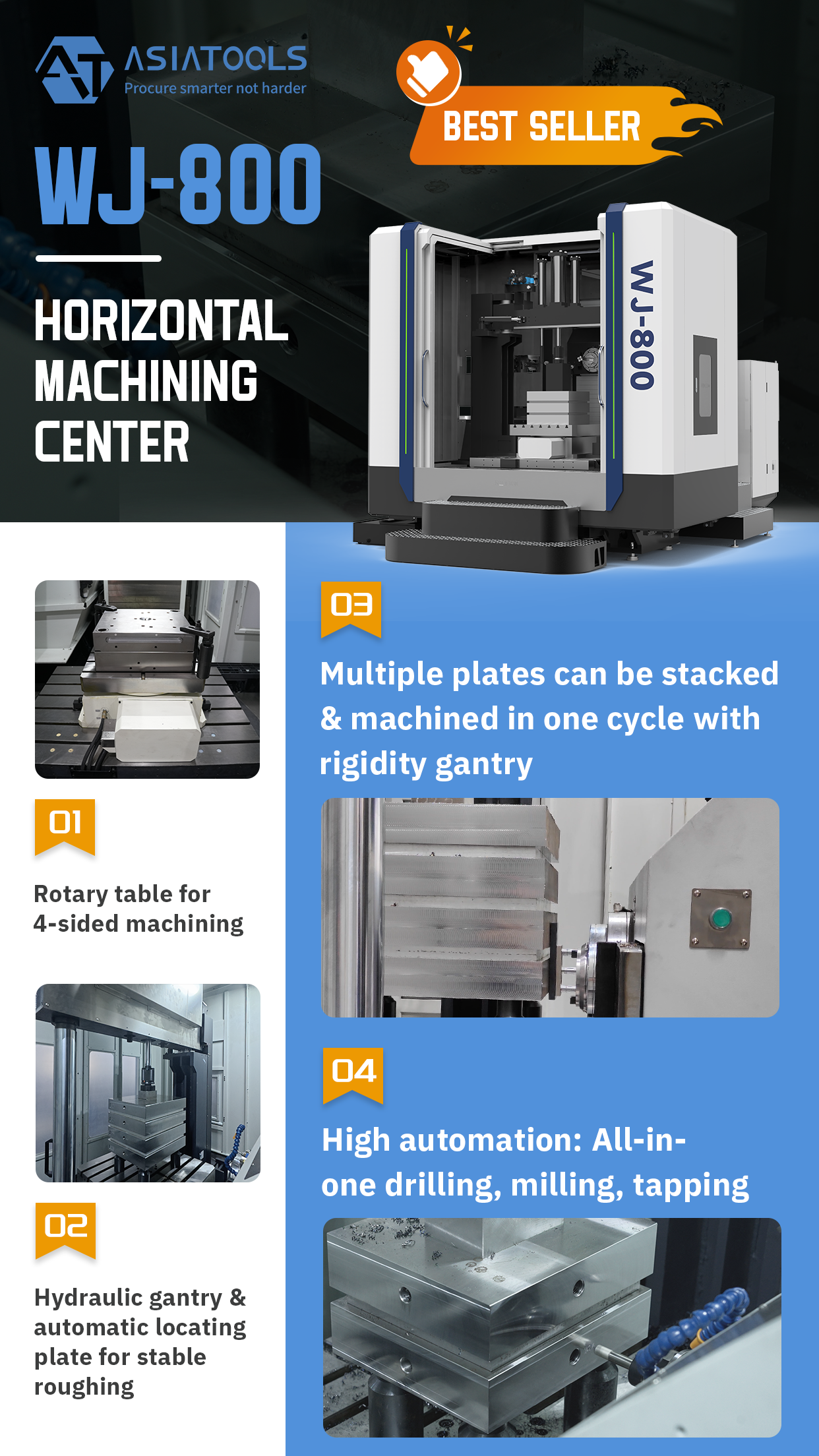
Spotlight: ASIATOOLS WJ-800 Horizontal Machining Center
While standard HMCs offer the benefits listed above, the ASIATOOLS WJ-800 takes efficiency a step further with specialized features designed for heavy-duty stability and automation.
Here is how the WJ-800 optimizes the horizontal machining concept:
A. 4-Sided Machining with Precision Rotary Table
Unlike standard setups that require multiple clamps, the WJ-800’s rotary table enables seamless multi-face operations.
- Benefit: Zero manual repositioning means higher accuracy and significantly faster throughput for complex box parts.
B. Hydraulic Gantry for Heavy-Duty Roughing
Stability is the core of the WJ-800. It features a rigid hydraulic gantry combined with an automatic locating plate.
- Benefit: This unique design locks the workpiece in place with immense force, eliminating vibration during aggressive roughing cuts and ensuring consistent cutting quality.
C. Multi-Plate Stacking Technology
Why machine one part when you can machine many? The WJ-800 allows for multi-plate stacking in a single cycle.
- Benefit: The robust gantry structure supports the weight of stacked plates, multiplying your productivity per cycle without sacrificing uniformity.
D. All-in-One Automation
The WJ-800 is not just a milling machine; it is a fully automated system integrating drilling, milling, and tapping.
- Benefit: Minimizes manual intervention and human error, making it the perfect solution for manufacturers looking to scale up production with high precision.
Conclusion
Horizontal Machining Centers are an investment in speed, quality, and long-term capability. By utilizing gravity for chip removal and robust structures for stability, they solve the inherent limitations of vertical machining.
For manufacturers ready to tackle heavy-duty roughing and multi-face complexity, the ASIATOOLS WJ-800 offers a powerful combination of hydraulic stability and automated efficiency, ensuring you stay ahead in a competitive market.