

In the mold manufacturing industry, precision and efficiency are critical. Many mold manufacturers still start machining directly from raw steel blocks. However, raw mold steel usually has uneven surfaces, scale layers, and dimensional deviations. These problems can significantly increase CNC machining time and reduce final product accuracy.
This is why 6-side milling has become a standard process for mold steel preparation.


1. Improving Dimensional Accuracy
Raw mold steel blocks are typically produced through rolling or forging processes. As a result, the surfaces are often not perfectly flat or square. When these blocks are used directly in machining, the misalignment can lead to dimensional errors.
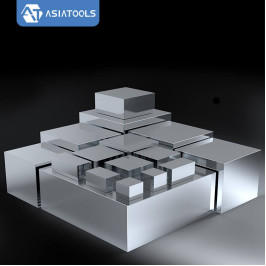
Through 6-side milling, all six surfaces of the steel block are precisely machined and squared. This process ensures:
- Better perpendicularity
- Accurate dimensions
- Consistent parallel surfaces
According to industry machining standards, properly milled steel blocks can achieve dimensional tolerances around ±0.01–0.02 mm and excellent squareness control. This significantly improves the precision of mold components.
2. Reducing CNC Machining Time
When a raw steel block is not properly prepared, CNC machines must first spend time flattening the surfaces before starting actual mold machining. This additional work increases machining time and production costs.
Pre-machined mold steel blocks with six milled sides allow customers to start CNC machining immediately. The benefits include:
- Faster setup time
- Reduced machining steps
- Lower production cost
For many mold factories, this can save 30–50% of preparation time during CNC processing.


3. Improving Surface Quality
Another challenge with raw mold steel is the presence of surface oxidation and uneven hardness. These factors can cause excessive tool wear and poor machining performance.
6-side milling removes the outer layer of the material and creates clean, uniform surfaces. This leads to:
- Better cutting stability
- Reduced tool wear
- Improved surface finish
High-quality mold steels such as P20 mold steel, 718 mold steel, and S136 mold steel perform much better after proper pre-machining.
4. Ensuring Better Assembly Accuracy
In mold manufacturing, many components must fit together precisely. If the base material is not perfectly square, assembly errors may occur later in the process.
Six-sided milling guarantees that all surfaces are flat and perpendicular, providing a reliable reference for machining and assembly. This greatly improves the final mold accuracy and stability.
Conclusion
For mold manufacturers, using 6-sided milled mold steel blocks is a simple but highly effective way to improve production efficiency and product quality.
The key advantages include:
- Higher dimensional accuracy
- Reduced CNC machining time
- Better surface quality
- Improved assembly precision
By starting with properly machined mold steel blocks, manufacturers can reduce machining problems, extend tool life, and produce molds more efficiently.